Monday, February 18, 2019

How to Make Your Own Nicotine-free Smoking Mixes


Have you ever had to fill out some sort of form, maybe for a job or some sort of poll, and they want to know if you are a smoker?  I  always check “no.”  I am not a smoker.  Well, at least I don’t smoke much.   I have long maintained that the real culprit in commercial cigarettes are the chemicals added to the tobacco and paper, things such as moisturizers, flavors, things to keep the cigarette burning, etc. etc.  There are anywhere from 70 to 250 such chemicals, depending on who you believe.  If the tobacco companies had to list all the ingredients on the label, there’d be no room on cigarette containers. 


Let’s just assume that “the government,” in its ultimate wisdom of knowing what is best for us, decided to put all the tobacco companies out of business and you could no longer buy tobacco at your corner market.  Guess what?  Various species of tobacco grow wild throughout the country. 

Here in the West, there is a widespread introduced species of tobacco commonly known as Indian tobacco (Nicotiana glauca) or tree tobacco (it can grow up to 25 feet tall). (In fact, there are wild tobaccos throughout North America.)  We allow it to grow out back because its yellow tubular flowers attract hummingbirds.  This plant would kill you if you ate it, but it can be dried and smoked.  It is far more potent than commercially grown tobaccos, and in general I would not recommend driving your car and smoking this plant at the same time.  If the bureaucratic do-gooders ever outlawed tobacco, there’d still be no shortage of wild tobaccos around the country.

All that said, though I have smoked tobaccos in the past (commercial and wild), today I prefer to make my own non-nicotine smoking mixes for those times when I sit out back and think about important things.

My blend varies from season to season, depending on what wild leaves I have picked and dried. 


The blend will typically have some dried peppermint and/or white sage (Salvia apiana).  This gives a sweet flavor to the smoke, somewhat like menthol in cigarettes.  Any of the sages and mints would do -- even those growing in your garden.  This should be no more than 1/5 of your blend. 

Horehound (Marrubium vulgare) is a European medicinal herb that can now be found throughout most of North America and the world. It has a long history of use for treating coughs and sore throats when used as a hot tea or candy.  I learned recently that it can also be blended into your smoking mixes and there still may be some good effect from the horehound, even if you smoke it.  It is a true mint, after all, and it smokes well, though it doesn’t add that menthol-like quality to your smoking mix as do the other mints.

I often add dried manzanita leaves (Arcostaphylos sps.), which were used by American Indians of the Southwest in their smoking blends.  This smokes very well, though there is little taste or flavor.  The most commonly known variety is the kinnikinnik, or Arcostaphylos uva-ursi, which is not a bush or tree like the other manzanitas but is a trailing vine.  Regardless which variety I use, I let them air dry, and then crush them into small pieces. The manzanita leaves are all somewhat tough and leathery so it will be necessary to break them into small bits so they can smoke.  I have heard that the flavor of this particular leaf is improved a bit if it is aged, and if it is allowed to slightly ferment, in much the same way that one might age certain tobaccos.  However, I  have never taken the time to experiment with this, since the dried and crumbled leaves smoke quite well.

I sometimes add dried and pulverized willow bark (Salix sps.), usually red or arroyo willow.  This adds a pleasant flavor, and was apparently used in traditional American Indian smoking blends.  A tea from the willow bark has effects similar to aspirin, and can be drunk or applied to wounds to relieve pain.  In fact, the original aspirin came from the inner back of willows, which contains salicin.  We have heard some folks say that smoking the willow bark in their mixes also provides some pain-relieving qualities.  That’s not been my experience, but you can try it and see what you experience.


I add the dried leaves of mullein.  Mullein (Verbascum thapsus) is now a common weed in the U.S. though it’s a European native.  Of the many virtues of mullein, it is good in a tea for breathing problems, even asthma.  Interestingly, mullein has long been smoked to improve the breathing passages.  If you’re going to smoke, you really ought to include mullein in your mix.  The large leaves of mullein have the texture of flannel.  I generally pick leaves from the first year growth.  Mullein lives for two years, and in the second year it sends up a tall flower spike and produces smaller leaves.  (By the way, these fresh leaves make pretty good toilet paper).  Mullein is common throughout the country in fields and along streams.

I  usually add a little bit of mugwort to my mix -- no more than about 1/5 of the mix -- since it produces a very pleasant aroma when burned.  Mugwort (Artemisia sps.) is found along streams and the dried leaves, rolled into a cigar shape, were used by early Native American in Southern California as punks for transporting coals.  When I collect mugwort for smoking, I typically just collect the leaves from the lower stalk of the plant that have dried on the plant.  On the other hand, if I am collecting the leaves for their medicinal values, I would collect the leaves green, clean them, and then dry them for storage. 

There are other herbs that I sometimes add in various amounts.  I like the leaves of passionflower (Passiflora sps.), a somewhat common vining plants throughout much of the west, the south, Europe, Mexico, and even the Hawaiian islands.  The leaves have a sweet odor
and don’t seem to irritate the throat or mouth.  Medicinally, the tea from passionflower is drunk in cases of insomnia or nervousness.  The flowers are used medicinally also, but I usually only smoke the leaves. 

I also add a small amount of Damiana leaves to the blend which I buy from the health food store.  This is a plant which supposedly grows in the wild around, but it is a plant I do not know and haven’t encountered it.  It makes a delicious tea, and a very pleasant smoke.  Damiana leaves were also smoked by the ancient Aztecs.  I have long enjoyed the fragrance of the damiana tea, and it does create a pleasant aroma when smoked. 

When I have it, I add a few pulverized pieces of sweetgrass braids to the smoking blend.

Yerba Santa (Eriodictyon sps.)  is a common southwestern herb found in dry and desert-like places.  It is very fragrant, and usually sticky.  There are several varieties, and all have a history of being used as a tea for breathing and bronchial problems.  It is sometimes added to smoking mixes for its fragrance, and apparently because some folks believe that the beneficial effects on the lungs and bronchial tract still carryover when you smoke it.

Interestingly, you’ll notice that many of the herbs I have listed are frequently used as the primary remedy for coughs, sore throats, asthmatic conditions, etc.  At the very least, there is the presumption that by smoking herbs that are generally beneficial to the throat and lungs, that you will be somewhat counteracting the harmful effects of the smoke.  Whether this has any real scientific basis is uncertain.


Coltsfoot is an herb commonly found along roadside ditches and wet areas in the eastern parts of the United States.  It is a two year plant, and the large first year leaves are the ones typically gathered for smoking.  Coltsfoot has been used as a smoke for at least a few centuries, and there is the belief that smoking it can actually be somewhat good for a sore throat.

You can make your own blends and determine what you like. 


I don’t smoke a lot – I might sit out back maybe once a month or so and smoke my hand-made elder pipe.  I’m not addicted to it, like the  person who can’t stop chain smoking commercial cigarettes.  I simply likes to smoke occasionally, at special times, while thinking about a particular subject. 

I am quick to reiterate that I am neither encouraging nor endorsing smoking of any sort.  I certainly do not advocate the use of regular commercial tobacco, since its use is related to a host of diseases. But perhaps the use of wild nicotine-free herbs can help you cut down on the harmful tobacco.   If you do choose to smoke, moderation is the key.  

And if you’re one of those people who simply isn’t going to go out and collect your own herbs, then try the Store at www.SchoolofSelf-Reliance.com or send $12  to School of Self-Reliance, Box 41834, Eagle Rock, CA 90041.  
Nyerges is the author of “Guide to Wild Foods,” “Foraging California,” “How to Survive Anywhere,” “Self-Sufficient Home,” and other books. He leads regular survival and wild food walks. He can be reached at www.SchoolofSelf-Reliance.com, or Box 41834, Eagle Rock, CA 90041.


COMPARISON OF COMMON NON-NICOTINE SMOKING HERBS


Availability in wild

 How prepared

Flavor **

Harsh-ness

Aroma **

How used medicinally *

Coltsfoot

Common in wet areas in Eastern U.S.

Dry the first year leaves

Mild, bland

Mild

Mildly sweet

Tea for bronchial problems

Damiana

Uncertain

Dry the leaves

Good, “herbal”

Medium

Very pleasant, like incense

*

Horehound

Very common

Dry the leaves

Mild

Mild

Bland

Tea for coughs, sore throats

Mint(s)

Common in wild and gardens

Dry the leaves

Mild

Medium

Mild, sweet

Many uses.  Good tea for digestion.

Manzanita

Widespread in west and southwest

Dry the leaves

Mild

Medium

Bland

*

Mugwort

Widespread along streams

Dry the leaves

Sagey

Medium to harsh

Sweet, like incense

Many uses


Mullein

Widespread in fields

Dry the first year leaves

Bland

Mild

Bland

Used as tea for asthma and breathing problems

Passionflower leaf

Widespread vine in west and south

Dry the leaves

Bland

Medium

Sweet; has been compared to marijuana

Used as tea; natural sedative

Sage(s)

Widespread in gardens and in wild

Dry the leaves

Sweet, adds a menthol quality

Medium

Sweet, sagey, like incense

Many uses

Yerba santa

Widespread throughout the west

Dry the leaves

Somewhat sweet, “medicinal”

Medium to harsh

Fragrant smoke

Used as tea for coughs, breathing problems

Willow

Widespread along streams worldwide

Dry the young bark, shred it.

Bland, not noticeable

Medium

Bland

Used as tea for pain-reliever


*  For medicinal uses of herbs, see any of the books by herbalist Michael Moore.

** In general, Bland flavor and aroma indicates that there is no strongly identifiable flavor or odor, and that the herb blends well with other smoking herbs.


Sunday, February 17, 2019

Global Warming: Fact or Fabrication?


“SOME LIKE IT HOT” : Is “global warming” a fact or fabrication?
Robert Haw speaks about Global Warming


[Nyerges is the author of several books, including “Self-Sufficient Home,” “Extreme Simplicity,” and others.  He can be reached at www.SchoolofSelf-Reliance.com]

Robert Haw, former JPL employee, recently spoke to a packed audience at Eaton Canyon Nature Center on the subject of “global warming,”  a nearly two-hour presentation where hard data was presented. 

Haw became more acutely interested in the subject since 1988, when NASA scientist Dr. James Hansen testified before Congress that the data shows that the earth is warming.  Haw was skeptical at first, and continued to research the subject.  After the release of Al Gore’s famous “Inconvenient Truth” documentary, Gore started the Climate Reality Project where workshops were people could be trained in presenting the Gore slide show.  Haw took this training, and has since developed his own Powerpoint to present the salient facts of “global warming,” also sometimes referred to as “climate change.”

Haw begins with data from the SMAP (Soil Moisture Active/ Passive  satellite), which circles the earth 14 times a day measuring soil moisture. This data shows the actual dryness or wetness of soils. The SMAP data shows a clear drying trend, as does other satellite data, especially of agricultural areas.


Haw is a focused man, working to demonstrate the authenticity of each point before he continues, as if we’re in a college-level course on climatology, or math, where each point is predicated on numerous other points.  He tells us that there are 7 billion people on the earth today, and everyone’s livelihood depends on a stable climate. Everyone is burning fossil fuels, directly or indirectly, which causes pollution, he states.

This, among other things, releases carbon dioxide into the environment. Carbon dioxide in the environment has been measured according to a standard established by Dr. Keeling (of Caltech) who set up an observatory in Hawaii in the 1950s to measure the CO2 count.  Today, there are hundreds of CO2 measurement stations around the world, following the techniques established by Dr. Keeling.

Carbon dioxide levels in 1960 were 310 ppm; by 2016, they were  410 ppm.  What does this mean?  More CO2 means more heat, and more heat means, among other things, melting of snow.  Scientists use a variety of data to calculate “average world temperature,” which was 54.5 degrees f. in the early 1900s.  Today, the average world temperature is 56 degrees.

This heat “goes” somewhere, according to Haw, with real consequences.  The bulk (94.3%) of the increased world heat from CO2 is absorbed by the oceans, which results in slightly higher ocean temperatures. 

The biggest concern about melting of ice in the Arctic is the melting of the frozen swamps in this region which releases methane gas, a greenhouse gas. Haw points out that methane has 86 times the warming potential of CO2, meaning that ice melt could increase more rapidly as the process of releasing methane proceeds.

To demonstrate his point, Haw shared records of recent high temperature records.  For example, Pasadena in 2017 had 35 days over 95 degrees (usual is 6). In 2018, there were 26 days over 95 degrees, including an all-time high temperature on July 6 of 116 degrees f.

Haw points out that heat, and heat-related sicknesses and diseases, are now the leading cause of death in the U.S. 

As a result of rising temperatures, ice melts at the poles, and this raises sea levels. This is measured by several methods, including satellite and on-the-ground observations.  Not only is the perimeter of the ice measured, but also the thickness.  Today, ice thickness in the Arctic is about 1/3 of the thickness of the early 1900s.

Currently, the sea level rises about 4 millimeters a year due to ice melt.  If the pattern continues unabated, the sea level rise could potentially create millions of refugees in the next 30-40 years.

Haw pauses to address the concerns of those who are called the “climate change deniers,” who claim this is all fake news.  One of the points brought up by such “deniers” is that the earth normally cycles through these changes through thousands of years, into ice ages, and back out again, with the cycle repeating with no apparent assistance from mankind.  This cycle, known as the Milankovich Cycle – the long periods which cause Ice Ages – are explained by the tilt of the earth in relation to the sun (the 23 ½ degree tilt which causes our weather), and the 26,000 cycle known as the Precession, as the earth moves around the sun. As these two cycles coincide, the cycles of Ice Age, to melting, occur naturally.  The big difference, emphasizes Haw, is that the Milankovich cycle takes hundreds, if not thousands of years to bring about its changes. By contrast, the warming effects of our use of fossil fuels has sped up this process so that we’ve seen thousands of years of climate change occurring in the last 50 years.

“Global warming deniers” also point to periods of heavy rain, such as California has been experiencing in December of 2018 through February of 2019, and elsewhere.  However, as a result of more CO2 in the atmosphere, a warmer atmosphere holds more water.  Thus, the world’s hydrological cycle is affected by there being an increase of 4 to 5% humidity from about 40 years ago. The result is more rain when there are storms. 

Haw’s “Some Like it Hot” Powerpoint also details the U.S. cities where flooding now routinely occurs during storms and high tides, cities such as Miami, La Jolla shores, and Norfolk, Virginia. 

Haw refutes each of the points of “global warming denyers,” one by one with the actual facts, and asserts that global warming is very real, that it’s urgent, and that we are the cause.

Haw spends a considerable amount of time in his presentation detailing the short term and long term actions that would help to avert the radical consequences to our western way of life.  “If we want to survive,” he says, “we need to change. The change can be voluntary, or it can be mandatory.”  Haw details many of the solutions put forth by politicians, such as “cap and trade,” regulations, and raising the cost of fossil fuels.

“The real problem,” he says, “is that we all have too much stuff and we continually want more.  All that stuff takes energy to make.”  Though he feels it’s a good short-term solution to switch to electric vehicles, he feels that we need to learn how to power-down and just use less energy.

Haw points out that he has about 1/20th of his household’s carbon footprint that he had 10 years ago.  He does this by driving an electric car and bicycling.  For a water heater, he uses a heat pump water heater, which costs more initially, but less in the long run.  He advocates reducing all natural gas use, and replacing gas furnaces with heat pump heaters. 

There’s nothing wrong with putting solar panels on your roof, he points out, but more importantly is to learn to do with less, and have fewer vehicles overall.  Haw is a great example of someone who puts their belief into action.  “We need to simplify,” he emphasizes.  “It’s about using less energy and having less stuff.”

“Don’t we have a moral duty to future generations to preserve a world worth living in?  Think Golden Rule,” he suggests.

Robert Haw can be reached at  roberthaw2008@gmail.com.

"The Longest Straw" -- a film about how L.A. gets its water.


“THE LONGEST STRAW”

A Film by Samantha Bode

How L.A. gets its water, and how we can do better at water conservation.


[Nyerges is the author of “How to Survive Anywhere,” “Self-Sufficient Home,” “Extreme Simplicity: Homesteading in the City,” and other books.  For information about his books and classes, he can be reached at Box 41834, Eagle Rock, CA 90041, or www.SchoolofSelf-Reliance.com.]


Samantha Bode was wondering about how Los Angeles got its water.  When she learned that there’s a 338-mile aqueduct that brings the water into the Los Angeles basin, she decided to walk its entire length to see it for herself.  She and the other producer of the film, Angela Jorgensen, financed it all themselves, with some additional help from Kickstarter, a grant, and other fundraising campaigns. 

At a recent presentation at Patagonia Pasadena, Bode shared her video account of her 65 day journey, a film which she produced and calls “The Longest Straw.”

One of her first experiences involved seeing L.A. Department of Water and Power (LADWP) trucks at Mono Lake, and wondering what they were doing there. It’s because that’s owned by LADWP, and the L.A. aqueduct was built in 1913 to bring water from the Lower Owens Valley to the exploding population of Los Angeles. Today, 5,000 gallons of water flow south every second, and dry wells in the central Valley are one of the many results of the voracious water appetite of the Los Angelenos.

“The Longest Straw”  wasn’t a dry academic presentation of the politics and economics of water, though along the way you learned a lot about water, and water in Southern California in particular.  The film is really more of an adventure story of discovery, from the Cascades in Sylmar at the aqueducts southern terminus, all the way to Mono Lake, 338 miles away.  The film is very personal, taking you along with Bode and her various hiking partners, feeling more like a Jack Kerouac journey of self-discovery.

Bode states that she decided to take this long hike by impulse, and her film shows us how she packed up and got started at Sylmar, hiking north. 


In her first few days of her hike, she passed by the remnants of the St. Francis dam (also known as the Francisquito Dam), whose construction was overseen by Mulholland, who was the chief engineer for the city of L.A. water department. The dam, about 10 miles north of Santa Clarita,  catastrophically failed on March 12, 1928, with the deluge killing an estimated 431 people as the water rushed to the sea.  “The Longest Straw” shows us all the highlights of Bode’s journey, with key points about water along the way.  About 15 miles of the Pacific Crest Trail parallels the aqueduct, for example, and the aqueduct was designed so that it flows entirely by gravity, with no pumping.

As Bode walked north, she hiked though the 130 miles where the aqueduct passes through the desert.

“In the desert, all I thought about was water.  Spending a week in the desert without water makes you in complete awe of the miracle of turning on a faucet,” she explains.

LADWP owns about 240,000 acres in the Owens Valley, including the land where the WWII Japanese internment camp was built at Mazanar. 

Bode describes her trials and tribulations along the way, and the itinerant hikers and locals met along the way, each with a colorful story. From Braley Creek, to Lone Pine, to Independence, we watch her mile by mile trek, with constant commentary on the environment, and the people she meets. We meet tribal members along the way, and ranchers who’ve lives have been affected by the fact that Los Angeles owns their local water sources.  One of the tribal members tells us, “The aqueduct is not a river.  It has just one use – to move water to Los Angeles. A river snakes around, and there are many benefits along the way.”


After 65 days of hiking, Bode arrives at Mono Lake, which is 13 miles long, 9 miles wide, and about 160 feet deep.  L.A. gets about 16,000 acre-feet of water a year from the Lake, depending on the water level of the lake.

If you’re looking for facts and figures about water usage in the city of Los Angeles, you should go to the DWP website, or even Mayor Garcetti’s website.  This film has some of that, but it’s really a close up and personal look at the environmental consequences of what it takes to keep L.A. alive.  Bode constantly points out that the large appetite for water by L.A. residents, and its wasteful use, has consequences to people far away that we’ve never met.  But Bode has met some of them, and is telling their side of the story in this environmental film.

Bode’s presentation includes things that  L.A.-area residents can do in their own lives to use less water.   “We need to cut out some stuff,” says Bode, meaning that some of our wasteful water habits need to stop. 

She shares the names of several of the local agencies which have been educating the public about water frugality.  She shares several steps that people can take, such as recycling household grey water into one’s yard.  She encourages people to plant native plants, and plants that don’t require excessive watering. 

Bode shares some of the ways to save and utilize rainwater, such as inlets in curbs, and simply collecting rainwater in buckets (with lids) for landscape use.  An average rooftop of 1000 square feet has the potential to divert up to 3000 gallons of water fairly quickly in a storm, assuming you have the means to collect it. 

According to The Longest Straw website, “With Samantha's inquisitive perspective as a window into this controversial topic, we learn much about the experience of diverse groups such as the Paiute-Shoshone people, cattle ranchers, ecologists, hikers, residents, and the Los Angeles Department of Water and Power.  By working together, humanity can ensure the future of reliable freshwater for all.”


For more information about Bode’s educational efforts, you can go to www.thelongeststraw.com.

Monday, February 11, 2019

"Cooking the Native Way: Chia Cafe Collective." Book Review


COOKING THE NATIVE WAY, a New Book by Heyday publishing.


[Nyerges is the author of “Foraging California,” “Extreme Simplicity,” “The Self-Reliant Home,” and other books. For information on his books and classes, go to www.SchoolofSelf-reliance.com.]

We’ve all heard about how the indigenous people of Southern California lived off the land with a diverse diet, yet modern Americans seem to persist with the myth that the diet of the past was a survival diet of bland acorns and squirrels.  Nothing could be further from the truth.

Undoubtedly, some native peoples of the past went hungry during times of drought.  After all, “store” was a verb, not a noun.  Yet, as the indigenous people have begun to tell their own stories, a fuller picture emerges of a diverse and healthful diet that could have been the envy of contemporary people just about anywhere else.

“Cooking the Native Way: Chia Café Collective” boasts 10 authors: Barbara Drake, Daniel McCarthy, Deborah Small, Leslie Mouriquand, Cindi Alvitre, Craig Torres, Abe Sanchez, Lorene Sisquoc, Heidi Lucero, and Tima Lotah Link, all of whom are long-time educators in Native American food, traditions, beliefs, and anthropology.  The full-color book is beautifully done, and if one were to buy it only for the pictures, you’d not be disappointed.


“Cooking the Native Way” is ostensibly a cookbook of native foods such as the acorn, cactus, mesquite, chia, yucca, nettles, and others. But it is so much more!


The authors begin by sharing their story of how their teaching about native foods, and compiling recipes, evolved into the Chia Café Collective organization.  You get an introduction to the people and the places where they teach, and why it’s important to preserve this heritage.

The Mother Earth Clan (Drake, Sisquoc, and Alvitre) share with the reader the clan rules to live by, which are guidelines for cultural survival and sustainability.  For example, all things are sacred and all things are alive.  Respect your elders by listening and learning.  Always be truthful.  Always give before you take.  What you do will come back to you, good or bad.

The photos are fantastic, and uplifting to see.  The section on Places introduces the reader to all the Southern California locations where the authors teach, with photos of their workshops.

The heart of the book is the Recipes section, beginning on page 60.  You learn about the key plants used by native peoples, how to prepare them into delicious dishes, and where to purchase them.  Some are commonly foraged in the wild.  The reader is also given the details of why these traditional foods are so good nutritionally. 

Since acorns are perhaps the single stereotypical food of native California, we are treated to everything we need to know about the acorns, such as how to remove the tannic acid, how to store them, the remarkable nutritional content, and how to turn the acorn flour into some amazingly delicious breads, cookies, and dumplings. 

A chapter on the popular chia seed explains the history of this seed in the native diet, and how to collect, and process it into different dishes.  Perhaps not widely known is that the commonly available chia seed (from Trader Joes, for example) is not the chia used in the past.  The native chia, sometimes called golden chia, is Salvia columbariae, whereas the commercially-available chia is Salvia hispanica.  The nutritional values of each is very similar, however.


In the section on prickly pear cactus, you learn how to select the nopales or cactus pads, how to clean them, and how to turn them into a variety of tasty dishes.  Details are also given for processing the cactus fruits, which are the closest thing to watermelon you’re going to find in the wild.

This is a refreshing book that is enjoyable to read, a pleasure to look at, and full of tried and tested recipes.  The philosophy throughout is reminiscent of other recent books that have attempted to record the diversity and beauty of native foods, such as “Ethnobotany Project: Contemporary Uses of Native Plants,” (by Blurb.com) which is a collaboration of nearly 30 authors, including the authors of “Cooking the Native Way.”  Another excellent book in this vein is “Enough for All: Foods of My Dry Creek Pomo and Bodega Miwuk People” by Kathleen Rose Smith, also by Heyday books.  

“Cooking the Native Way: Chia Café Collective” was published in 2018 by Heyday books in Berkeley.  It’s an 8 ½ by 11 format, 161 pages.

Thursday, February 07, 2019

Extreme Simplicity: Homesteading in the City


Extreme Simplicity: Homesteading in the City


[Nyerges is the co-author of “Extreme Simplicity: Homesteading in the City,” and other books. He also conducts on-going classes.  He can be reached at www.SchoolofSelf-Reliance.com]

Since there has been an increase in popularity in our “Extreme Simplicity” book, published in 2002, I wanted to share some of that book. The ideas expressed in the book are somewhat timeless, and are every bit as relevant today as when the book was written.


 “Everybody thinks of changing humanity, and nobody thinks of changing himself.”  -- Leo Tolstoy.


THE HOUSE

When we purchased our home in the mid-1980s, it was one of the most dilapidated places in the neighborhood.  Clearly we had work ahead of us.  A duplex rental with a distant owner and many tenants, the building had been sorely neglected.  Yet, we were glad to discover as those first weeks and months went by that the damages due to neglect were mostly cosmetic or easily repaired.

There were no serious problems with the building’s structure, apart from a leaky roof, which we replaced as soon as we could afford to.   The water pressure could be better, which would mean replacing some of the pipes.  And the electrical system, though surely fine for the 1950s, would need to be modernized.

Our need to make these improvements gave us an opportunity to reconsider our priorities for the house in light of our longer-term goals.  We wanted our various projects to steer us in the direction of self-reliance – even in an urban setting – and in the direction of living our lives lightly.  All this we proposed to do within a modest budget on a city lot in Los Angeles.

The interior of the building was generally shabby, and the back section was especially very run-down.  We re-tiled the front kitchen and bathroom and painted all the walls in the front section of the duplex so we could rent it out for income.

We removed the garbage disposals from both kitchens and put them in the city’s recycling bin. These costly and noisy appliances aren’t necessary and cause endless plumbing problems.  Plus, think about it: What are we doing when we use a garbage disposal?  Using extra water and extra electricity to grind up “garbage” so it can pass down the sewer lines and end up eventually in the ocean.  Our choice is to give our food scraps to our animals, or our worm farm/ compost pit.

We also removed the automatic dishwashes from each kitchen. We’ve heard interesting debates about whether these modern devices use more or less water than simply washing dishes by hand. Usually electrical use is not factored into such debates, and besides, we find that the quiet time spent washing dishes, looking out the window toward the chicken coop, is a waking meditation.  We salvaged whatever hardware we could from the dishwashers, and sent the rest to the recycling center.

Although the house came with two natural-gas wall heaters, one was dangerously corroded and we had it disabled.  The other we used only when necessary.  Eventually, we installed a fireplace in the back, unheated section. Many people have been surprised, even shocked, to learn that we had no “modern” heating – our merino wool sweaters and our fireplace were usually adequate during the Southern California winters.

Nor did we have “central cooling.”  In the summer, however, we discovered that our location had very still air, and we didn’t get much of a breeze through the house. Partly, this was due to the fact that we closed and locked our doors at night.  Over the years, we replaced regular screen doors with steel security doors, so we could leave the doors open to the air all night without worrying about a break-in.   This has made a terrific difference, allowing cooler air to flow through the house.

We mentioned the old roof, which leaked terribly during winter rains, but we couldn’t afford the expense of a new roof right away, and we were convinced that the existing dark brown roofing would keep the house much hotter in summer than necessary.  We researched the many “liquid rubber” roofing products on the market.  For a few hundred dollars, we painted the whole roof with a coat of white Roofer’s Best, which is sold primarily for use on the metal roofs of trailers to help keep down solar-heat absorption, and not as a roof sealant.  It did, however, seal most of our leaks.  Its main value has been to keep the house 15 to 20 degrees cooler during that summer than it had been with the dark roof.  It is amazing to be inside a cool house, with no air conditioner, when outside summer temperatures are over 100 degrees f.   We simply used natural principles – in this case, the reflective properties of a white roof.  Eventually, we had our roof professionally reshingled in the lightest color available.

Keep in mind that we lived within Los Angeles city boundaries – a major metropolitan area. We were not living out in the country, nor were we living off-the-grid, supplying all our household power with solar, or going without electricity altogether.  Yet, we feel that all too many city dwellers have used an urban home as their excuse not to adopt some of the methods practiced by country people, thereby missing all kinds of opportunities for special learning and savings. Even given the constraints of urban life, we have tried to grow as much of our food and provide as much of our own oxygen as possible, recycling whatever we can, collecting rainwater, and living our lives with no excessive use of resources.

THE YARD

While the house wasn’t in dire shape, the yard was a wasteland. The previous residents had used the front yard alongside the driveway to park and work on their cars, resulting in soil as hard-packed as adobe.  Some weeds and crabgrass had managed to pop up here and there after rains, but otherwise it was a barren wasteland.

The garage door was broken and fall off and had been propped up with a two-by-four.  One of our first projects was to have an aluminum garage door installed, which is lighter, easier to operate, and need no maintenance.  Instantly, we had another usable enclosed space.

The front courtyard was a hodgepodge of introduced ornamental plants.  A stand of banana trees in a planter had never been thinned, and the expanding roots were breaking the brickwork.  We had to think the bananas and rebuild the brickwork.

Over time, we gradually replanted vegetation in the front yard and courtyard, including several fruit and nut trees.  There was a large pine tree in a very tight spot by the corner of the house.  Severely malformed, it grew at a 30 degree angle into the neighbor’s yard.  We don’t ordinarily approve of cutting down trees, but we made an exception in this case because we saw no way to right the tree, and because of the fire hazard of a pine tree so close to the house.  So we felled, split, and dried it, and eventually it became firewood.

As we cleaned up around the back of the house, we discovered that the porch area had a patio of bricks that had been completely covered with dead grass and soil.

The back yard was mostly bare except for some grasses in the lower area.  There was only one tree, a grapefruit, growing in the backyard, and we often wished aloud that we’d inherited any other kind of fruit tree.  After all, grapefruits were way down on our list of desirable fruits.  And yet, a few years after moving in, we finally juiced the tree’s fruit and found ourselves enjoying one of the best juices we’ve ever had.

In the following 20+ years that we lived there, we planted many more trees in the back yard – at least a dozen fruit trees.

One of our first building projects out back was a compost pit and worm farm, because we don’t believe in tossing out recyclable garbage for the city workers to take to the dump.  We also made a vegetable garden, and a coop and yard for our chickens and potbellied pig.  We placed our rabbit hutch (which we built) directly over the compost pit so that urine and droppings continued to feed the earthworms, and we rarely had to clean out the  hutch.

We regarded our small urban homestead as a research station.  Here we were able to try out many gardening, recycling, and building ideas to see if they will really work or if they need refining.  We endeavored to let our living home laboratory be truly an extension of our values and our thinking.

We also realized that one’s home is much more than the physical structure, and that one can improve upon and elevate mundane physicality by thinking more broadly and more clearly.  This we strived to do in little ways and big ways, which we relate in the book.  We are aware that how we do things is as important (if not more important) that what we do.


Wednesday, February 06, 2019

Year of the Pig


 What does the Year of the Pig symbolize?


A pig represents luck, overall good fortune, wealth, honesty, and general prosperity.  The pig symbolizes a hard-working,  peace-loving person, someone who is truthful, generous, patient, reliable, trusting, sincere, and giving.  The pig represents a sociable person who has a good sense of humour and understanding.


When I learned that this was the Year of the Pig beginning February 5,  I called it the Year of Otis, for my pot-bellied pet who was with me for 19 years before he died.

OTIS


It was the spring of 1993 when Otis came into our family.  My wife and I had talked about getting a pig, and the pot belly “craze” was fading out.  Though we toyed with the idea of breeding pot-bellied pigs, Otis had been neutered, so that was not a viable idea.  But that was OK, because we fell in love with Otis right away.


We learned a lot about the nature of “pig-ness” during Otis’ life.  In fact, this was partly why we got Otis in the first place – we were going to learn about the nature of pig-ness, which is also an aspect of human-ness. 


We learned that he certainly had a good memory, especially as it related to food.  He once discovered a bag of carob pods that I had in the living room, and he nearly ate half the bag before I caught him.  After that, any time he got into the house, he always went right to that spot where the carob had been.


Though we’ve heard that pigs are very smart, you can’t really compare them to dogs, for example.  Dogs might not have pigs’ great memory, but they seem smarter due to their loyalty to their masters. I’m sure that Otis always recognized me from other people, but loyalty?  I don’t think so.  Pigs don’t seem to want or need close affinity to people in the way that dogs do.  Nevertheless, later in his life when Otis was mostly alone, we did develop a “closeness.”


Yes, Otis was a pig, and yet he was such an individual!  I learned to know what his sounds and grunts meant, so I knew when he was happy, when he felt threatened, when he was worried, and when he liked (or disliked) someone.  His range of vocal sounds was broad and fascinating.


My vet once told me that Otis lived well over twice the average life for a pot-bellied pig.  He’d gotten much slower in his last two years, and became slow and unsteady on his feet.


I felt a great empathy for Otis. He was a big guy, for sure, but his personality was such that he always seemed like a little boy.  When Otis was dying,  I thanked him for the good life we had together, and  I whispered in  his ear that everything was OK, and that I loved him. He just grunted his friendly “oink” in return.  Otis never got up, and he died a week later, on Hannukah.


YEAR OF THE PIG

I spent New Year’s Eve for the Year of the Pig at the Puti Meditation Center in Alhambra, with Helen. It was open to the public, but about as close to a family gathering as you can get.  The meals was made by the various members, and we began by sharing a home-made meal.  There were some dance performances by the teens, and much socializing and talking.  About 45 minutes was spent chanting one of the healing chants.  From the large TV screen in the center, we watched a message from the founder  Master JinBodhi, who extolled everyone to treat each other well, which not only makes the world a better place but also improves one’s karma.

Though 95% in Mandarin, I was still able to follow the majority of the commemoration because of the degree of pantomime used – recall that words are only a small part of total communication—and I also received periodic translations from Helen.

Bodhi Meditation was founded by Meditation Master JinBodhi in 1991 with a mission to impart practical, effective meditation techniques as a way of strengthening the energy of the physical body, and to inspire the spiritual mind so as to bring greater health and joy to the world at large.  He adopted the 12 Great Vows of the Medicine Buddha and began teaching the practices of Bodhi Meditation, embarking on a journey to liberate humans.  Buddhism has been around for about 2,600 years, a bit longer than Christianity, and both have resulted in countless sects which espouse one aspect or another of the basic tenets.


Monday, February 04, 2019

The Bioscarf: A big scarf with something extra


PRODUCT REVIEW: The Bioscarf


[Nyerges is the author of “How to Survive Anywhere,” “Foraging California,” “Extreme Simplicity,” and other books. He has been leading survival classes since 1974.  More information at www.SchoolofSelf-Reliance.com]

I recently had the opportunity to test something called the “bioscarf.”  Yes, it’s a scarf, and everyone knows I like scarfs.  I’ve worn them all my life.  I used to love alpaca wool scarves, and then I was given a Polartech scarf, and I preferred that. 

I like long scarves too, but not the very long scarves that really get in the way.  I cannot get the story of Isadora Duncan out of my mind, who loved very very long silk scarves, and she enjoyed wearing them in her convertible.   While driving one day in September, 1927, her enormous scarf got caught in the rear hubcabs of her car, and she was strangled to death.  Ghastly!  Well, I don’t drive a convertible and I cannot imagine wearing a scarf over six feet long!  Or can I?

The bioscarf actually measures in at seven feet long, and 9 inches wide. That’s big, but not too big to get caught in your car’s wheels.  Byclists be careful.

I like its size, and though it comes in white, olive, black, and camo, I couldn’t resist the camo.  But its main selling point is not the size – it’s what’s hidden inside the fabric.

Bioscarf is actually a stylish air mask that keeps your neck and head cozy while filtering out unwanted air contaminants, germs, second hand smoke, pollen and other allergens. This can protect you from colds, flus, pneumonia, tuberculosis and allergens.  Bioscarf is the first scarf with an N95 air filter layer built right into the  scarf.

When tested by Nelson Labs against normal masks and respirators,  the bioscarf outperformed some of the most popular masks available today with a 99.75% average filtration efficiency. In addition to doing its job effectively,  the bioscarf is made from sustainable materials. Post-consumer recycled PET water bottles go into the fabric, while the signature labels are made from recycled PVC. It is also built to be long lasting and reusable, meaning less disposable air filters in the landfill.   And this filter is reusable – just wash the scarf by hand from time to time after use.


So, if you’re in a situation where you might otherwise put on a face mask, you can just wrap the scarf over your mouth and nose, and breathe through it.  Maybe you’re an allergy sufferer, visiting somewhere with poor air quality, on you’re on a bus or plane where everyone is sneezing and coughing.   Bioscarf will give you some protection.

I like the multi-use aspect of the bioscarf, and when I’m wearing mine, it gives me the feeling of being protected, as if I’m living in a Mad Max, Book of Eli, or Bladerunner, world.  But that’s a crazy idea, since everyone in those futuristic dystopian societies would probably be wearing rags.  Still, the bioscarf is one of those garments that you’ll be glad  you have. It’s functional, and provides a layer of protection that other scarves just don’t provide.

They run about $45, and are available at eartheasy.com, or Amazon.

Wednesday, January 16, 2019

Walking Into the Early Past of Los Angeles


WALKING INTO THE EARLY PAST OF LOS ANGELES

[Nyerges is the author of “How to Survive Anywhere,” “Self-Sufficient Home,” “Foraging California,” and other books. For more information about his books and classes, go to www.SchoolofSelf-Reliance.com.]


Each year on my birthday, I have attempted to do something special to recall the passage of years and the significant events of my life.  Usually, this has taken the form of a run where I review each year of my life, and look at where I’ve been, and where I think I should be going.

In addition to this review this year, Helen and I chose to go into downtown Los Angeles to look-again at some of our cultural treasures, and to also look at the early history of this town.

First, we went to the “new” Catholic Cathedral at Hill and Temple.   If you’ve never been there, you really should check it out.  No one will ask you whether or not you’re a Catholic, and they will welcome your $22 fee to conveniently park in their lot.  The Cathedral of Our Lady of the Angels is an impressive structure – Catholic’s really know how to build churches.


You enter the vast plaza, planted with unique trees, and you enter into the high-ceilinged church, whose walls are lined with huge tapestries depicting the various saints and special ones of the Church.  There are plenty of little side sanctuaries where you light a candle to the Virgin of Guadalupe, or various other saints.  
There’s a lot to see, especially the little statues scattered here and there. I especially liked the fountain on the east end of the courtyard, whose floor is painted with the constellations.  The store offers you any and all of the keepsakes of Catholicism that you can ever hope to find. 

I was brought up in Catholicism, and so I had a natural interest in this large monument in the heart of the City of Angels.  But, more than that, on my birthday, I wanted to walk in Yangna, the original Indian village from which sprang Los Angeles.

No one really knows where the village center may have been.  The Cathedral is probably the western edge of the living area that extended eastward to the Los Angeles River. Native people used the river, but would have lived in the slightly higher ground, such as where the Cathedral is located.  The Civic Center is often believed to be the center of Yangna, as well as the center divider of the 101 just south of the MTA headquarters.  No one really knows, but this village occupied the triangle roughly bordered by the Pasadena Freeway, the 101, and Los Angeles River.

According to research by Dr. Harry Kelsey of the Los Angeles County Museum of Natural History, A Yangna settlement existed on the land of the current Los Angeles Civic Center, and it was a favorite trading place for native people.  Governor de Neve, six months prior to the establishment of the Los Angeles pueblo in 1781, had undertaken preliminary diplomacy with the natives who lived there, in order to develop friendly relations before Spanish settlers began moving into the area. De Neve was apparently making some progress, but was replaced by Pedro de Fages later that year. Then, by 1828, a German immigrant purchased the land of the Yangna community and obtained the help of Mexican officials to evicted the entire Yangna community who had been living there for possibly up to 3000 years.

Spanish missionaries in the 1700s impacted the Yangna people, and after the fall of the Spanish mission system, Mexican families founded the new pueblo where the native people once had their village.  We think of it today as Olvera Street.

After we left the Cathedral, we drove to the Terminal Annex Post Office where it’s easy to park, and walked to the Our Lady Queen of the Angels Catholic Church, across the street from Olvera Street.  This is the original Catholic church, going back to the early days, with its courtyard bearing a resemblance to the early mission style of architecture.  This is a small church compared to the Cathedral, and it was full of the serious, mostly older, Catholics, who are there to pray and to cry. There is none of the hipster atmosphere that you witness at the Cathedral, and none of the cameras hanging from every hand looking for a photo op. This is the real thing, and you’re quiet here, or you’re told to leave.  This church is very reminiscent of the many old churches that you find still in small towns of Mexico.


After a bit, we crossed the street to the Olvera Street plaza, and read the names of the founding fathers of Los Angeles on a somewhat inconspicuous plaque while mariachis played in the background.   The 11 founders were Villavicencio, Rodriguez, Quintero, Vanegas, Lara, Mesa, Moreno, two Rosas, Camero, and Navarro, of the town they called El Pueblo de la Reina de Los Angeles sobre el Rio de la Porciuncula – the Pueblo of the Queen of the Angels on the River Porciuncula – Los Angeles for short.


I was a bit amazed at how little traffic we encountered getting into downtown on a Friday, and I was struck by how quiet Olvera Street was. It was the first time I was there when it was not shoulder to shoulder. Of course, I usually go there on the weekends or on Dia De Los Muertos. I learned that the mobs of office workers of downtown Los Angeles have learned how to adjust their schedules so that they are no longer there on Fridays.  It turns out that the busiest freeway day is now Thursday.

We browsed at many of the items sold at Olvera Street, mostly interested in the molcajetes and some of the beautiful art and woven objects from Mexico. 


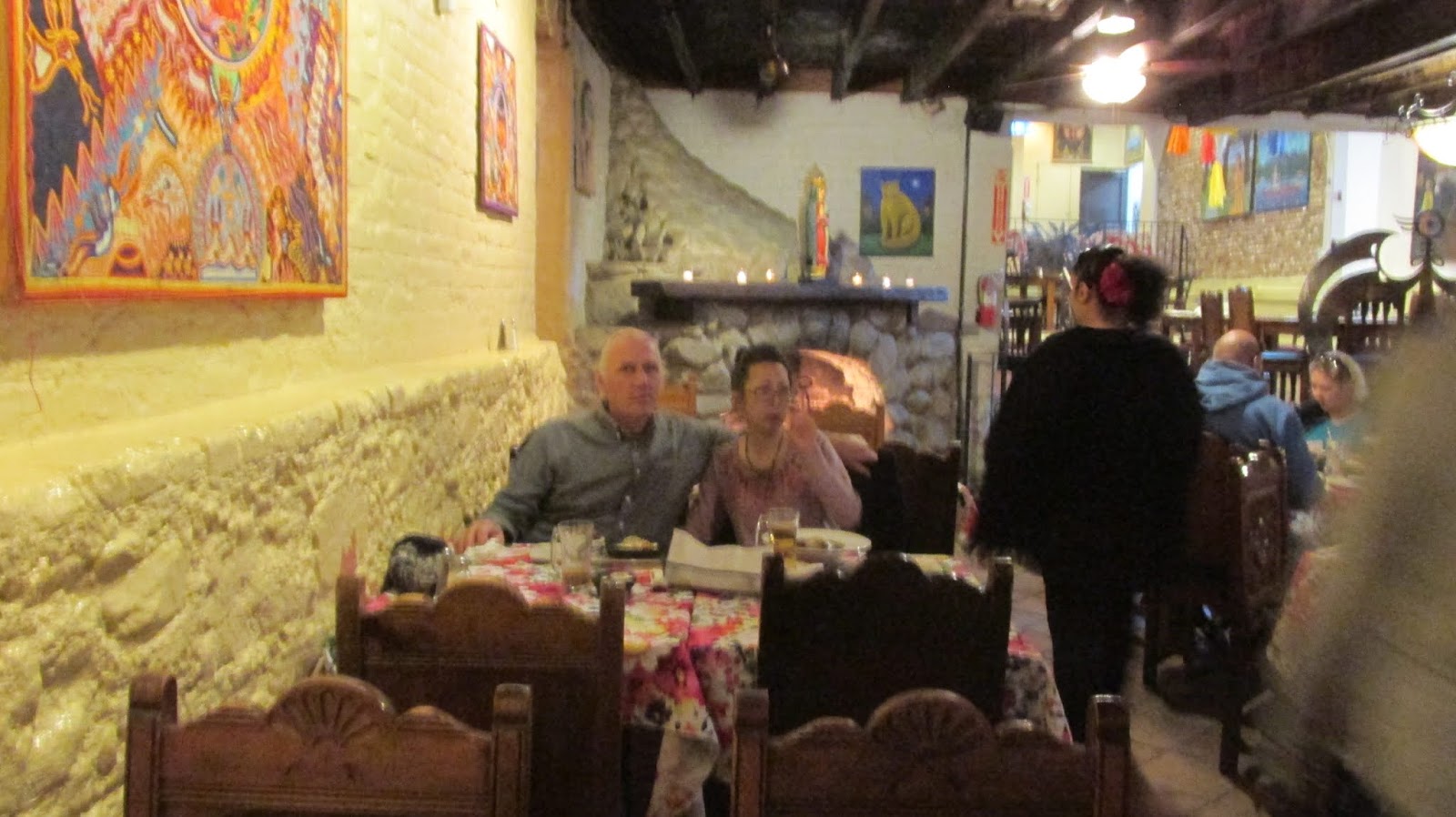
We finally wanted to get an early dinner, and so we went to a Mexican restaurant I’d been to before – I am very much a creature of habit, often going back again to my familiar places.  We went to Casa La Golondrina, at 17 West Olvera Street.  Inside, it was like going back more than a century to early Los Angeles as we could see the original wood, and fire was burning in the big stone fireplace in the corner. The restaurant was part of the Pelaconi house, built in 1855, and because it was such a quiet time, we enjoyed talking about the history of the building with the waiter and the proprietress.  We could imagine how this early city could function in the pre-electric days, with cooking by fire, and the springs and river bringing the water into the town via the zanja. 


Of course, if you only go to this part of downtown as a tourist, you miss the depth.  Within these several urban blocks was once the center of Indian culture, slowly pushed back by the Spanish missionaries, and then pushed back by the Mexican ranch owners, who were pushed  back again by the new Americans.  As you dig beneath the surface, you realize there was much pain and killing and suffering along the way.  Another part of the story is Chinatown, just to the north, where the Chinese workers came until they were marginalized and considered no longer needed.  It’s all a long a sordid history, painfully documented in such books as “The Other Californians: Prejudice and Discrimination under Spain, Mexico, and the United States to 1920” by Heizer and Almquist.

George Santayana  is famously regarded as telling us that we who do not learn from history are doomed to repeat it.  Los Angeles is probably not unique in the way that each culture builds atop the old one, and then tries to forget its past.  But such a great city as the City of Angels with its unique diversity provides us with the opportunity to learn from our past, and to respect and embrace all those who came before.  It would be a remarkable destiny for this great city if everyone chose to do that, though the jury is still out as to whether we are collectively learning from the past, or just repeating old mistakes.